As he prepares to assume charge of India’s diplomatic mission in Saudi Arabia, ambassador-designate Vipul sees the strategic relationship between the two countries scaling newer heights in the coming years, driven by converging interests, a strong institutional framework and opportunities created by the Kingdom’s Vision 2030 reform program.
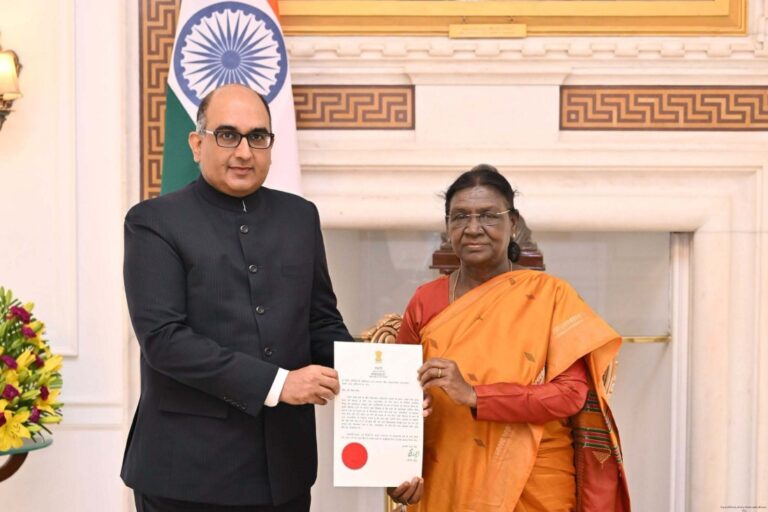
Having received his credentials from Indian President Droupadi Murmu in the last week of July, Vipul will soon travel to Riyadh to begin his duties.
“I feel very honored and privileged that my government has given me this opportunity to go and serve in Saudi Arabia,” he told Arab News in his first interview before taking charge.
“The posting as ambassador of India to Saudi Arabia is always very important.”
Vipul joined the Indian Foreign Service in 1998 and has served in Cairo, Colombo and Geneva, before becoming consul general in Dubai. He later served as joint secretary for the Gulf region at the Indian Ministry of External Affairs and as India’s ambassador to Qatar from 2023 to 2026.
“Our relationship is historic, it’s special and, of course, it is strategic,” he said. “The interests of both our countries converge. They always intersect, and therefore I think in the current situation, it becomes even more important that we continue to strengthen our strategic relationship.”
He added: “I only see our relationship going further, going to newer heights in the coming years. Over the last decade, our relationship has really strengthened.”
Following Crown Prince Mohammed bin Salman’s visit to New Delhi in 2019, India became only the fourth country to establish a Strategic Partnership Council with Saudi Arabia.
A year later, during the Kingdom’s presidency of the Group of 20, leading rich and developing nations, the two countries began forging partnerships and bilateral programs.
These received further impetus during India’s G20 presidency in 2023, when the Strategic Partnership Council held its first session, co-chaired by the crown prince and Indian Prime Minister Narendra Modi.
The institutional framework established through the council has since provided a platform for cooperation across a growing range of sectors. At the same time, Saudi Arabia’s Vision 2030 has opened new avenues in technology, infrastructure, renewable energy, minerals, healthcare, tourism, logistics, entertainment and investment.
“We have the Strategic Partnership Council between India and Saudi Arabia. The institutional framework for strengthening our cooperation across different areas is available through these mechanisms,” Vipul said.
“Both India and Saudi Arabia are growing economies. There are many opportunities for both our countries to work together, and with Vision 2030, the opportunities that are coming up … give several opportunities for Indians to get employment and to do business with Saudi Arabia.”

Investment and trade
Vipul sees considerable scope for increasing two-way investment, with companies and sovereign wealth funds from both countries looking at opportunities in each other’s markets.
“Both our economies are growing, so there is great opportunity for investments — both by Saudi companies and the sovereign wealth fund in India, as well as for Indian companies who are also looking at opportunities abroad to go into Saudi Arabia with an expanding economy, with lots of projects which are in the pipeline in Saudi Arabia as well (as) in many different sectors,” he said.
“There are many, many opportunities, and when I go across and talk to Indians who have been working in Saudi Arabia or who have some plans in Saudi Arabia, everyone is very excited with these opportunities. So, I see our relationship across the board going up and up.”
Trade and investment, he said, “will remain a priority for both our countries,” particularly as both economies diversify and pursue major development programs.
“There are many developments which are taking place in Saudi Arabia. There is a lot of focus on newer sectors, on logistics, on minerals, on mining, on renewable energy, on tourism, on logistics, on entertainment, and similarly in India,” he said.
“As we are growing, as our economy is growing, on infrastructure sector, on other sectors, including data centers, power, roads, highways, we need a lot of investments, and both our countries can continue to work together in many of these areas.”
Vipul said the potential was particularly significant because India and Saudi Arabia are both large, rapidly growing economies, while the Kingdom is also seeking to diversify beyond fossil fuels.
“This is something which has already been work in progress, and in the future many of these things will fructify even more, and our cooperation will go further,” he said.
A broad-based partnership
The incoming ambassador said the relationship now extends well beyond its traditional pillars, encompassing political ties, trade, investment, energy, culture, security and defense.
“We have strategic relations with Saudi Arabia. Over the past three years, these have strengthened in various dimensions, and as we go forward, I think across the board there are many, many opportunities for strengthening them further,” he said.
At the political level, he noted that the two countries remain closely connected at the highest levels, with regular meetings under the Strategic Partnership Council, including at the ministerial level.

“On trade and investment there are significant opportunities between our two countries. On energy of course Saudi Arabia is a very important partner for India, and on culture as well. Culture, security and defense.
“So, there are many, many areas in which both our countries are cooperating, are going ahead, and I think this will continue to enhance in the future as well.”
Technology is another area where Vipul sees considerable scope for cooperation, particularly as artificial intelligence reshapes economies and societies.
“AI is defining the world today. Overall, there are many sectors, and my priority as an ambassador will be to strengthen the relations on a wholesome basis,” he said.
Vipul, a graduate of the Indian Institute of Technology Delhi, who also holds a Master of Business Administration qualification from the Indian School of Business in Hyderabad, said his focus would be on strengthening the relationship across all its dimensions rather than concentrating on any single sector.
“There are many dimensions, and I certainly feel that in the coming years we will strengthen our relationship even further, which is already at a very good scale.”
Regional stability
Vipul’s assignment comes at a particularly sensitive time for the Gulf and wider Middle East, with the US-Israeli war with Iran having implications not only for the region but also for countries such as India.
The regional situation, which he described as “very concerning to everyone across the world,” makes it even more important for New Delhi and Riyadh to remain closely engaged.

Asked whether India and Saudi Arabia could cooperate to help restore stability to the region, Vipul pointed to the continuing high-level contacts between the two governments.
“There has been a constant touch at the leadership level between our countries. It’s very important that we have stability in the region, and that essentially for India, it is the development which is the most important for the country,” he said.
India has deep economic, social and strategic connections with the Gulf, including Saudi Arabia, making peace and stability in the region a vital interest for New Delhi.
“We have very, very big connections with the Gulf region, including with Saudi Arabia, and so it’s very important for us that peace and stability prevail in the region.”
Sports and new opportunities
Sports is another emerging area of bilateral cooperation, particularly as Saudi Arabia positions itself as a global sporting hub and prepares to host major international events.
“There are many opportunities for two-way investments in sports as well,” Vipul said. “You have the Asian Games coming up in Saudi Arabia, FIFA coming up in Saudi Arabia … so there will be a lot of infrastructure development for sports projects as well.”
“Saudi Arabia has established itself as a sporting power for the entire world, and I think that also rubs on to Indians. Everyone is looking at Saudi Arabia. Everyone is very excited about these opportunities.”
The Kingdom is set to host the Asian Games and the FIFA World Cup in 2034, making the coming years particularly significant for sports infrastructure and related investment.
For India, Vipul said, the growth of Saudi Arabia’s sports sector could create opportunities not only in investment but also in infrastructure, technology and other supporting industries.
A historic relationship
Reflecting on his forthcoming assignment, Vipul returned to the historic ties that have long connected the peoples of India and Saudi Arabia.
“Hajj is another important aspect of our relationship. It has bound the two countries together for centuries,” he said.
The ambassador-designate said he was eager to begin his tenure in a country whose importance to India extends across diplomacy, economics, energy, culture and people-to-people ties.
“I am really looking forward to this great opportunity that has been bestowed on me by the government of India, and I’m sure that I’ll have a wonderful time in the Kingdom of Saudi Arabia.”
