

- Resolution says attacks breach international law and pose ‘serious threat to international peace and security’
- Iranian actions aimed at closing international navigation through the Strait of Hormuz also condemned
The UN Security Council on Wednesday adopted a resolution condemning Iranian missile and drone attacks against Gulf states and Jordan. Thirteen members of the council voted in favor, while Russia and China abstained.
Resolution 2817, tabled by Bahrain on behalf of the Gulf Cooperation Council, was co-sponsored by 135 countries, representing one of the largest shows of support for a Security Council resolution in recent years.
It “condemns unequivocally, in the strongest terms” Iranian missile and drone strikes targeting the territories of Gulf countries and Jordan, describing the attacks a breach of international law and a serious threat to international peace and security.
It demands that Tehran “immediately and unconditionally” halts its attacks and provocations against neighboring states, including through proxy forces, and calls for an immediate end to all strikes. It expresses strong support for the sovereignty and territorial integrity of Gulf states and Jordan, and reaffirms their right to self-defense under Article 51 of the UN Charter.
The resolution deplores what it describes as Iran’s deliberate targeting of civilians and civilian infrastructure, including airports, energy installations, food-production and distribution facilities, and other critical infrastructure.
It also references Security Council Resolution 552 (which was adopted in 1984 and condemned Iranian attacks on shipping in the Gulf), thereby reaffirming the importance of freedom of navigation in international waters and shipping lanes amid concerns over threats to maritime traffic in the region.
It warns against any threats to maritime navigation, particularly in the strategically important waterways of the Strait of Hormuz and Bab Al-Mandab Strait, and highlights the importance of the region to global energy supplies and the flow of international trade.
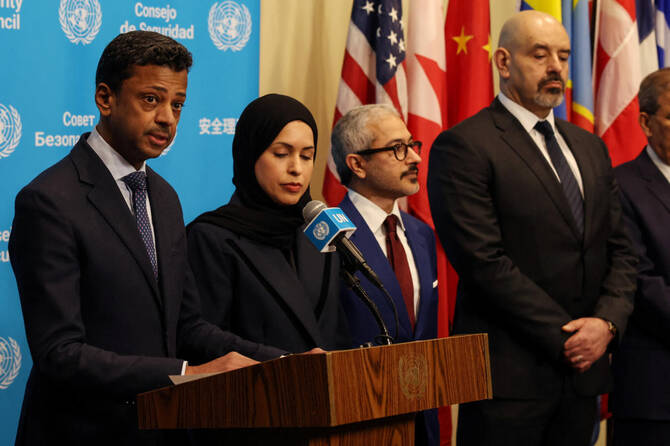
Speaking after the vote, Bahrain’s ambassador to the UN, Jamal Alrowaiei, said the broad backing for the resolution reflected global concern about the recent attacks against regional states.
“The fact that 135 countries co-sponsored this resolution bears witness to a collective conscience of just how dangerous Iran’s attacks are against the GCC and Jordan,” he said.
The Iranian strikes have targeted civilian infrastructure, residential areas and critical facilities across the region, causing casualties among civilians, he added.
“Our region is an essential pillar for regional and global stability, for energy security and the safety of trade,” he continued.
“Protecting our region is not only a regional matter, it is a common international responsibility closely linked to the stability of the global economy and international supply chains.”
Jerome Bonnafont, France’s permanent representative to the UN, said the resolution sends a clear signal in condemning the “indiscriminate strikes waged by Iran against its regional neighbors.”
He added: “For some 12 days now, the Middle East has yet again been plunged into war. This war poses grave risks to regional security and must stop now.”
Iran bears major responsibility for the escalation, Bonnafont said, citing the nation’s missile program, its support for regional militias, and threats linked to its nuclear activities.
James Kariuki, the charge d’affaires at the UK’s mission to the UN, said the council was right to condemn attacks that “pose a serious threat to our partners in the Gulf and to Jordan, and risk further regional and global conflagration.”
The UK is participating in coordinated regional defensive operations and will continue to support the Gulf states and Jordan, he added.
Israel’s ambassador to the UN, Danny Danon, said Tehran was attacking states in the region out of desperation as international patience with its actions was wearing thin.
“The regime in Tehran is trying to export terror and destruction but even the Security Council is running out of patience with Iranian aggression,” he added.
The US ambassador, Mike Waltz, said: “Iran’s strategy of sowing chaos, of trying to hold their neighbors hostage, trying to shake the resolve of the region has clearly backfired, and that was shown by this vote today.”
China’s ambassador to the UN, Fu Cong, said Beijing condemns attacks on civilians and nonmilitary targets, and supports the security concerns of Gulf states, but abstained from the vote because it believed the resolution did not adequately reflect the broader causes of the conflict.
“The fundamental way to prevent further deterioration of the situation is for the United States and Israel to cease their military operations,” he said.
While China does not support the Iranian attacks on Gulf Arab states, it believes the resolution lacked balance and did not sufficiently address the overall context of the conflict, he added.
Fu called on all parties to halt their military operations and return to dialogue and negotiations.
Russia’s ambassador to the UN, Vassily Nebenzia, said Moscow abstained from the vote because it, too, viewed the resolution as “extremely unbalanced.”
He told the council: “Talking about attacks against countries in the region in isolation from the root causes of the current escalation, specifically the aggression by the United States and Israel against the Islamic Republic of Iran, is impossible and unfair.”
The resolution “muddles up cause and effect” and fails to mention the attacks against Iran itself, Nebenzia said, arguing that the text could give the impression Tehran had carried out unprovoked strikes against Arab states.
But he added: “Strikes against civilians and civilian infrastructure are not acceptable under any circumstances — not in Iran, not in Bahrain, not in Jordan, not in Qatar, not in Kuwait, not in Oman, not in Saudi Arabia, not in the United Arab Emirates, not in Israel.”
Many diplomats said the strong level of international support for the resolution underscored a growing sense of alarm over the effects the attacks were having on regional stability, global energy markets and international trade routes.
Pakistan’s ambassador to the UN, Asim Iftikhar Ahmad, said Islamabad voted in favor of the resolution to show solidarity with the Gulf states and Jordan, while also calling for a broader diplomatic solution to the conflict.
He condemned attacks that target civilians and civilian infrastructure and reaffirmed his country’s support for the sovereignty and territorial integrity of the affected states.
He called for an immediate end to hostilities and a return to the negotiating table, warning that the conflict had already resulted in serious regional consequences, including civilian casualties and economic disruption.
Pakistan was also concerned about instability in Iran, Ahmad said, and he reiterated Islamabad’s support for Iranian sovereignty and territorial integrity.
Millions of Pakistani nationals living in Gulf countries have been exposed to the fallout from the conflict, he added, while disruptions to energy supplies and air travel were already affecting Pakistan’s economy.
Ahmad called for “maximum restraint” on all sides and a swift return to diplomacy to achieve a negotiated and lasting resolution to the crisis.